
Amazon’s Texas AI Campus Puts 7.65 Gigawatts Behind the Meter
The permit is a maximum authorization, not a meter reading. Its scale still shows how AI developers are turning power generation into part of the data-center stack.
Sources: TCEQ plain-language summary for permit 181033, TCEQ preliminary determination summary for GW Ranch, U.S. Senate Environment and Public Works inquiry to Pacifico Energy, AWS sustainability commitments, Tom’s Hardware report on Amazon and the GW Ranch site.
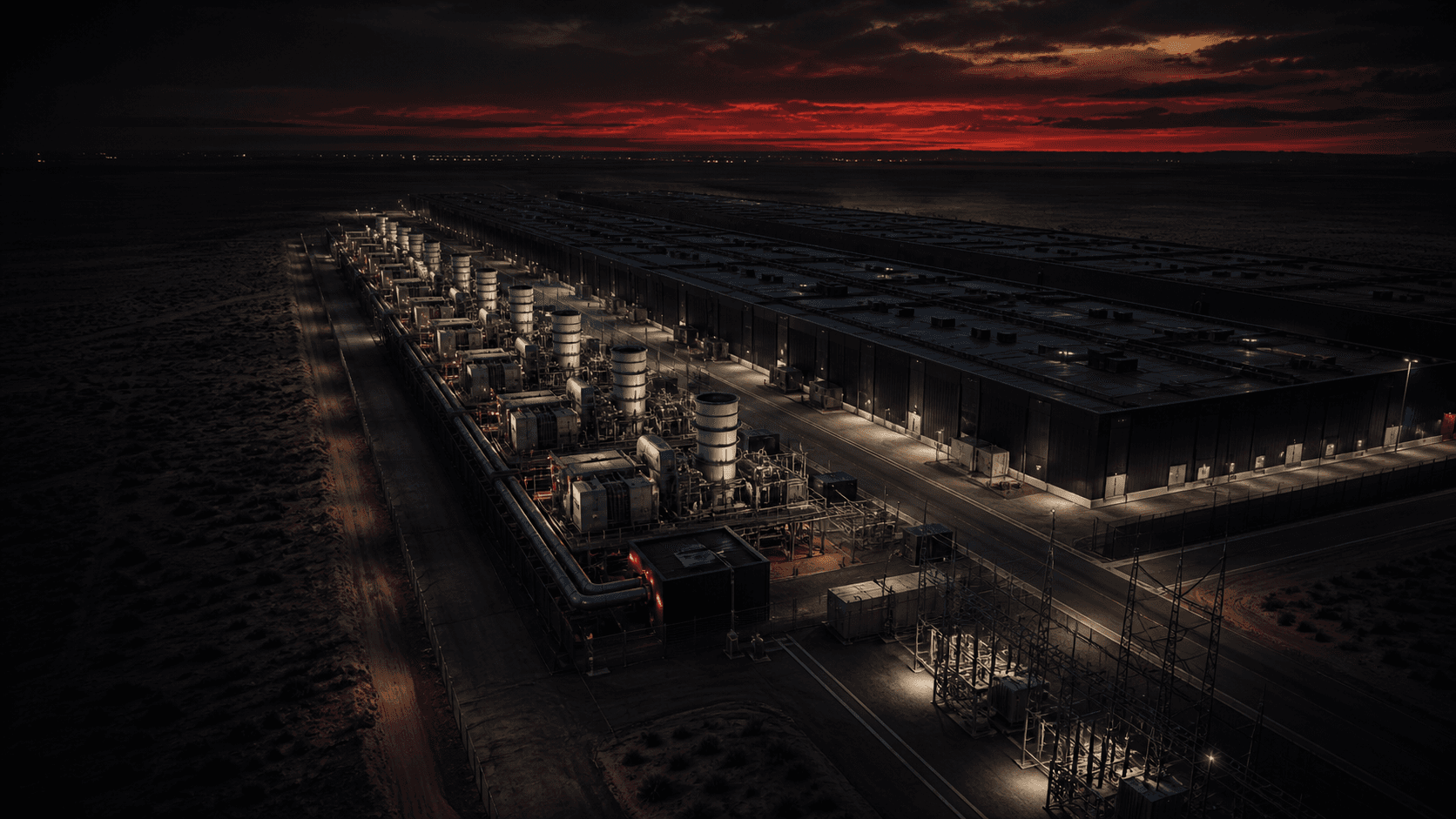
Amazon has acquired the Pecos County, Texas, site known as GW Ranch, according to reporting published August 8 and 9. The property carries an air permit for a private power system intended to serve an on-site AI data center campus. Texas Commission on Environmental Quality documents describe 35 simple-cycle natural-gas turbines with a nominal combined output of as much as 7.65 gigawatts.
That number is extraordinary, but it needs careful wording. The authorization defines the project’s permitted equipment and emissions envelope; it is not proof that all turbines have been built, that they will run continuously, or that annual emissions have already occurred. The TCEQ plain-language summary lists proposed greenhouse-gas emissions of 33,212,284.72 tons of carbon-dioxide equivalent per year at the permitted case.
Power is becoming part of the AI product architecture
The preliminary determination says the plant is intended for an on-site AI data center and would not be capable of buying or selling power through the local electric grid. That behind-the-meter design addresses a central constraint in AI infrastructure: a developer can procure chips and buildings faster than a regional grid can always approve and construct a multi-gigawatt interconnection.
Private generation can isolate a campus from some grid-queue delays, but it also moves energy choices into the data-center project itself. The carbon intensity, fuel supply, local air pollution, water needs, reliability, and stranded-asset risk become inseparable from the computing service. A cloud region is no longer only a collection of servers; at this scale it resembles an energy system with a data center attached.
A permit ceiling is not the same as actual emissions
Coverage calling the project the country’s largest pollution source is based on the maximum annual quantities authorized in the permit and comparisons with existing plants. Actual emissions would depend on final construction, turbine selection, operating hours, load, efficiency, maintenance, controls, and the project’s stated solar and battery components. Public reporting should keep those categories separate.
The ceiling still matters. Permits are written around what a facility may legally emit, and developers seek capacity they expect could be useful. Investors, customers, and communities need both numbers: the authorized maximum before operation and verified emissions after operation. They also need transparent treatment of methane leakage and of renewable-energy claims that may rely on contractual matching rather than hour-by-hour supply at the site.
Net-zero promises now face a physical accounting test
AWS says it remains committed to Amazon’s goal of net-zero carbon by 2040 and highlights efficiency, carbon-free energy, water stewardship, and waste reduction. A large dedicated gas plant does not by itself prove that the company will miss that target; net-zero accounting can include reductions, procurement elsewhere, and carbon removals. It does make the quality and boundaries of that accounting much more consequential.
Customers deciding where to run AI workloads should ask for region-specific marginal emissions, not only a global corporate average. Communities should receive construction status, expected operating profiles, water demand, criteria-pollutant estimates, emergency plans, and enforceable commitments about who bears infrastructure costs. The information should update as the project moves from permit to equipment to operation.
GW Ranch is a preview of the next phase of the compute race. When an AI campus can contemplate power on the scale of several conventional power stations, energy sourcing stops being a background sustainability metric. It becomes a core design decision that deserves the same scrutiny as model capability and data governance.
Quick questions
Is the GW Ranch power plant already emitting 33 million tons of CO2 each year?
No. The figure is the proposed annual greenhouse-gas quantity in the permit summary, not a measurement of current operations. Construction status and future operating levels determine actual emissions.
Will the project draw power from the Texas grid?
The TCEQ preliminary determination describes a private system for an on-site AI data center that would not be capable of buying from or selling to the local grid.
Does the project automatically violate Amazon’s 2040 net-zero pledge?
Not automatically. Net-zero is a portfolio-wide accounting target, but dedicated fossil generation increases the need for transparent, location-specific emissions data and credible plans for reductions or removals.