
Kentucky’s $100 Billion AI Campus Turns a Cold War Site Into a Compute Bet
The proposal combines a 1.8-gigawatt AI campus with new gas generation and battery storage. Its scale makes environmental review and local accountability part of the AI story.
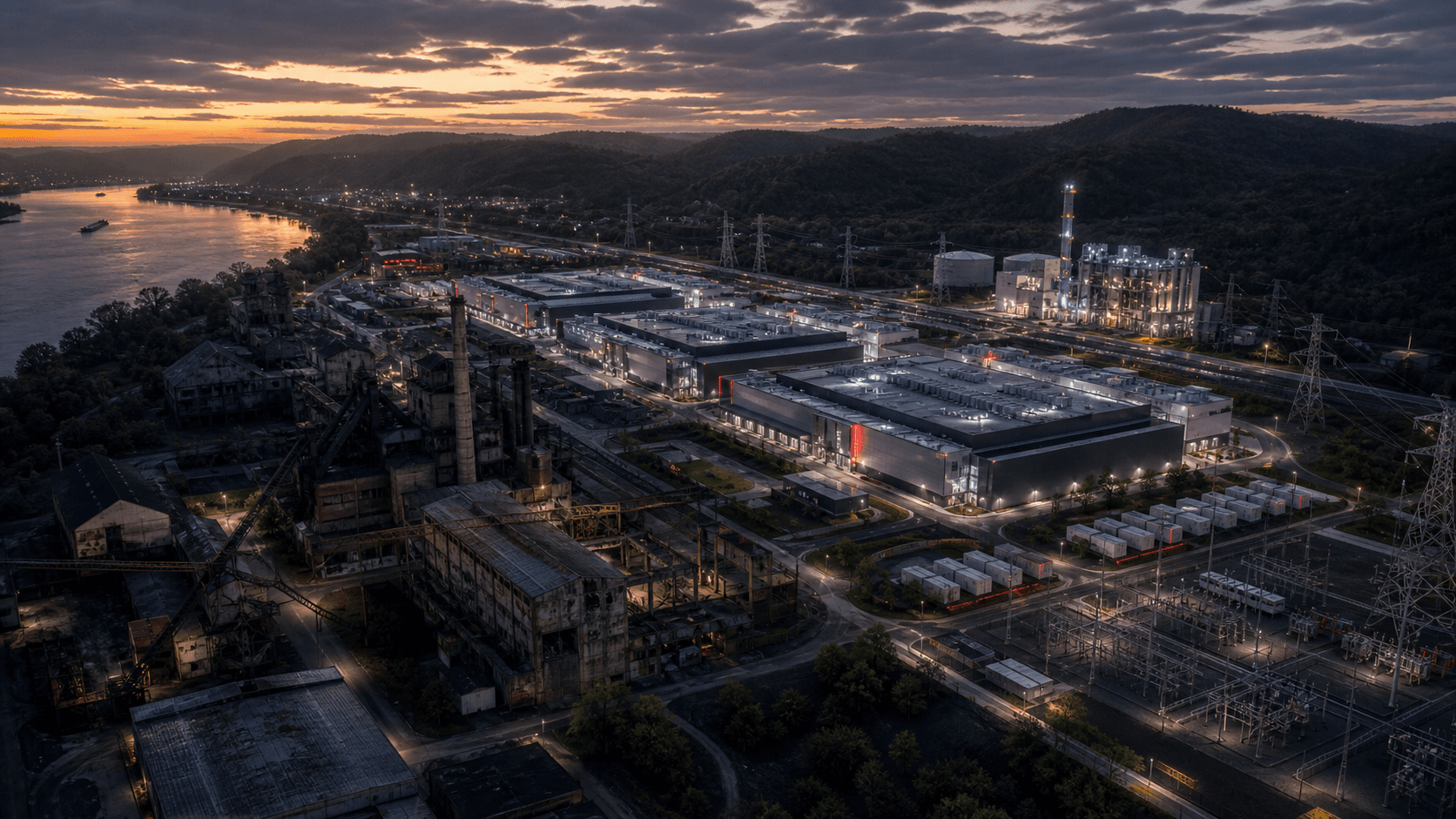
Sources: Associated Press reporting on the Paducah proposal, U.S. Department of Energy AI data-center initiative.
A former uranium-enrichment site in western Kentucky could become one of the largest symbols yet of AI’s demand for land and electricity. The Department of Energy selected Brookfield Asset Management to develop a proposed data-center and power complex at the government-owned Paducah Gaseous Diffusion Plant.
The plan described by the Associated Press carries a potential $100 billion price tag. NextEra Energy would build power infrastructure including 2 gigawatts of natural-gas generation and 2.6 gigawatts of battery storage to support a 1.8-gigawatt AI data-center campus. Construction is expected to run through 2031, and key utility approvals are still required.
AI infrastructure is becoming energy infrastructure
A 1.8-gigawatt campus is not simply another warehouse full of servers. At that scale, the project becomes part of regional grid planning. It influences generation, transmission, storage, water systems, construction schedules, and future electricity demand.
That is why data-center announcements increasingly arrive with dedicated power plans. Compute companies want predictable capacity; utilities need confidence that the demand will persist; regulators must decide how costs and risks are divided between developers and ordinary customers.
The history of the site cannot be treated as background
Paducah’s gaseous diffusion plant shut down in 2013 after decades of uranium enrichment. Cleanup, decontamination, groundwater treatment, and demolition are continuing, with federal work projected for decades.
Reusing industrial land can avoid some pressure to develop untouched sites, but it does not erase contamination or simplify environmental review. New construction, water use, and heavy energy infrastructure have to be evaluated alongside the site’s existing cleanup obligations.
The economic promise and the public questions coexist
Supporters point to construction, investment, and long-term technical work in rural western Kentucky. Those benefits matter. So do questions raised by local and environmental groups about water, air emissions, permitting, and whether electricity customers could be asked to subsidize infrastructure built for a private campus.
A credible development process should publish expected water use, emissions, grid impacts, cleanup boundaries, emergency plans, and the financial protections offered to ratepayers. Community review is not an obstacle to innovation; at this scale, it is part of responsible engineering.
The larger pattern extends beyond Kentucky
The Department of Energy has identified multiple federal properties for potential data-center development, including other former nuclear-industrial sites. The appeal is clear: large parcels, established transmission corridors, and federal control can shorten parts of site selection.
But AI capacity is not automatically a public good simply because it is built quickly. The public value depends on transparent costs, enforceable environmental conditions, durable employment, grid reliability, and accountability if the project changes course.
The AI race now has a physical footprint
Model launches can feel weightless on a screen. Paducah makes the underlying reality visible. Frontier AI is built from concrete, steel, chips, cooling equipment, gas turbines, batteries, transmission lines, and communities asked to host them.
The next phase of AI coverage should measure more than model intelligence. It should also ask how efficiently systems use energy, how openly projects disclose impacts, and whether the infrastructure supporting digital tools is designed with the same care we expect from the tools themselves.
Quick questions
How large is the proposed Paducah AI data center?
The proposal describes a 1.8-gigawatt AI data-center campus supported by new generation, storage, and transmission infrastructure.
Is the $100 billion project final?
No. It is a development proposal involving private partners, regulatory approvals, construction milestones, and ongoing federal cleanup work.
Why use a former uranium-enrichment site?
Large federal industrial sites can offer land and existing infrastructure, but reuse must be coordinated carefully with contamination cleanup, environmental review, and community protections.