
NVIDIA’s Ohio Backstop Makes AI Demand a Credit Question
A supplier guarantee can unlock construction that ordinary project finance will not fund alone. It also links chip sales, tenant payments, developer debt, and supplier credit inside one demand loop.
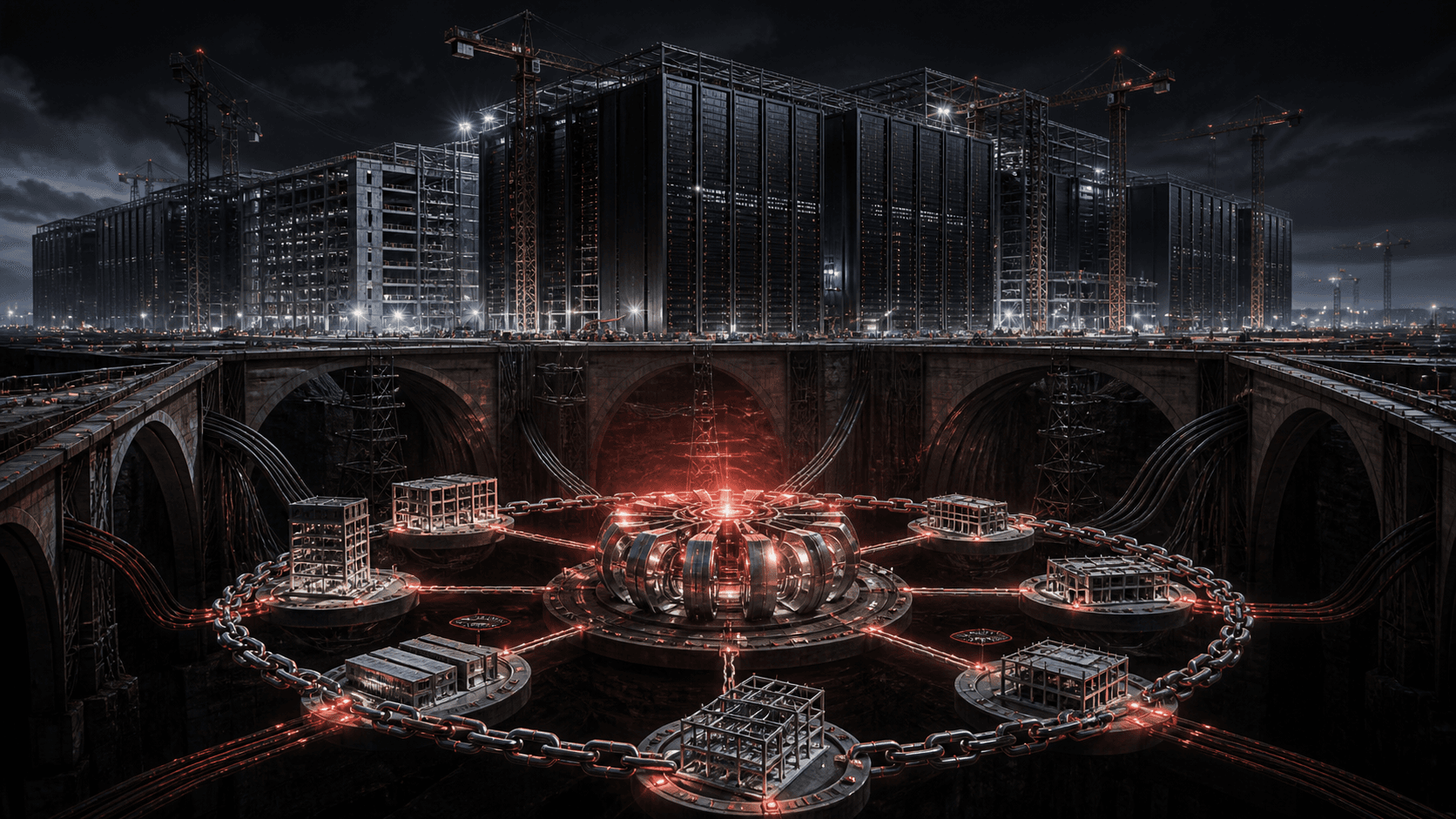
Sources: Axios report on OpenAI’s Ohio lease and NVIDIA guarantee, TechCrunch summary of NVIDIA’s investment and SEC-filed credit support, PORTS Technology Campus project overview, Federal Permitting Dashboard for the PORTS Technology Campus, OpenAI and SoftBank partnership with SB Energy.
The planned PORTS-Pike Technology Campus in Ohio now has an anchor tenant and an unusually powerful credit supporter. Axios reported on August 17 that OpenAI signed a 20-year lease for a campus developed by SB Energy. TechCrunch, citing NVIDIA’s announcement and an SEC-filed document, reported that NVIDIA will invest $1.5 billion in SB Energy, supply the site’s compute infrastructure, and provide up to $105 billion in credit support.
The reported initial information-technology capacity is 4.25 gigawatts, expandable by another 3.75 gigawatts. The project site says construction will be phased, with an initial 800-megawatt phase starting in 2026. It describes a broader 10-gigawatt campus on private land and remediated federal land at the former Portsmouth Gaseous Diffusion site in Pike County. Timelines, capacities, jobs, and community benefits remain project commitments until delivered.
The guarantee is part of the product economics
Large data centers are financed against long contracts, creditworthy payment streams, equipment value, and confidence that construction will finish. OpenAI brings demand but also faces enormous long-term compute obligations. SB Energy brings development and power infrastructure. NVIDIA brings accelerators—and, through a guarantee, balance-sheet support that can make lenders more willing to fund the build.
That does not mean NVIDIA writes a $105 billion check on day one. A guarantee is a contingent obligation governed by triggers, caps, phases, and contract terms. The maximum headline does not reveal expected exposure, collateral, fees, duration, or how obligations decline as OpenAI pays and capacity enters service. Those details are essential to judging risk.
NVIDIA also benefits commercially if the campus buys its systems. That alignment can accelerate deployment and keep the facility standardized. It creates a circular feature too: the supplier helps finance infrastructure whose tenant payments fund purchases from that supplier. Circularity is not proof of fake demand, but it makes independent utilization and customer-revenue evidence more important.
An 8-gigawatt plan is a sequence of options, not one building
Projects of this scale should be read phase by phase. The first 800 megawatts can have different financing, customers, equipment generations, and permitting conditions from later expansion. The option to grow to 8 gigawatts is not the same as a committed schedule to energize every gigawatt.
A phased design can protect capital by requiring milestones before the next tranche: completed remediation, permits, transmission, power generation, tenant acceptance, equipment delivery, and minimum utilization. It can also conceal risk if public communications aggregate optional future phases with contracted near-term capacity. Investors and communities need both figures.
The federal permitting dashboard identifies roughly 1,300 acres of private land adjacent to the Department of Energy Portsmouth site for the data-center complex. The campus site says SB Energy will fund grid upgrades and transmission and describes large new generation plans. Those commitments sit alongside environmental review, construction execution, equipment supply, and a long operating ramp.
The right metric is independent cash flow per energized phase
For NVIDIA, the useful disclosure is not only systems reserved or guarantees authorized. It is cash collected from equipment and services, contingent exposure outstanding, customer concentration, and whether financing support affects revenue recognition or pricing. For OpenAI, the question is whether product revenue and external customers can support the lease across technology and demand cycles.
For SB Energy and lenders, each phase needs a credible completion budget, power plan, tenant obligation, insurance structure, and residual-use case if demand changes. Accelerators age faster than the buildings, transmission, and generation built around them. Contracts should specify refresh responsibility and what happens when the preferred hardware changes before a 20-year lease ends.
The Ohio project is meaningful because it converts AI ambition into enforceable obligations among a tenant, a developer, a supplier, financiers, and government-linked infrastructure. The guarantee may be rational. Its discipline will be visible only if each phase can show real utilization and cash flow that do not depend indefinitely on the next partner financing the previous one.
Quick questions
Is NVIDIA investing $105 billion directly in the Ohio data center?
Reports describe up to $105 billion in credit support or guarantees, not an immediate $105 billion equity payment. TechCrunch separately reported a $1.5 billion NVIDIA investment in SB Energy.
How large is the PORTS-Pike data center?
The reported OpenAI plan starts at 4.25 gigawatts of IT capacity with an option for 3.75 gigawatts more. The broader campus is described as a phased 10-gigawatt development, beginning with an 800-megawatt phase.
Why does supplier-backed financing matter?
It can reduce lender risk and accelerate construction, but it also links equipment sales, customer demand, and credit exposure. Analysts should track actual utilization, cash collection, and outstanding guarantees by phase.