
Containerized AI Data Centers Move the Cloud’s Hardest Questions to the Edge
A mobile data center can keep inference running when the network disappears. It also puts valuable models, sensitive data, heat, power, and accountability inside one physical box.
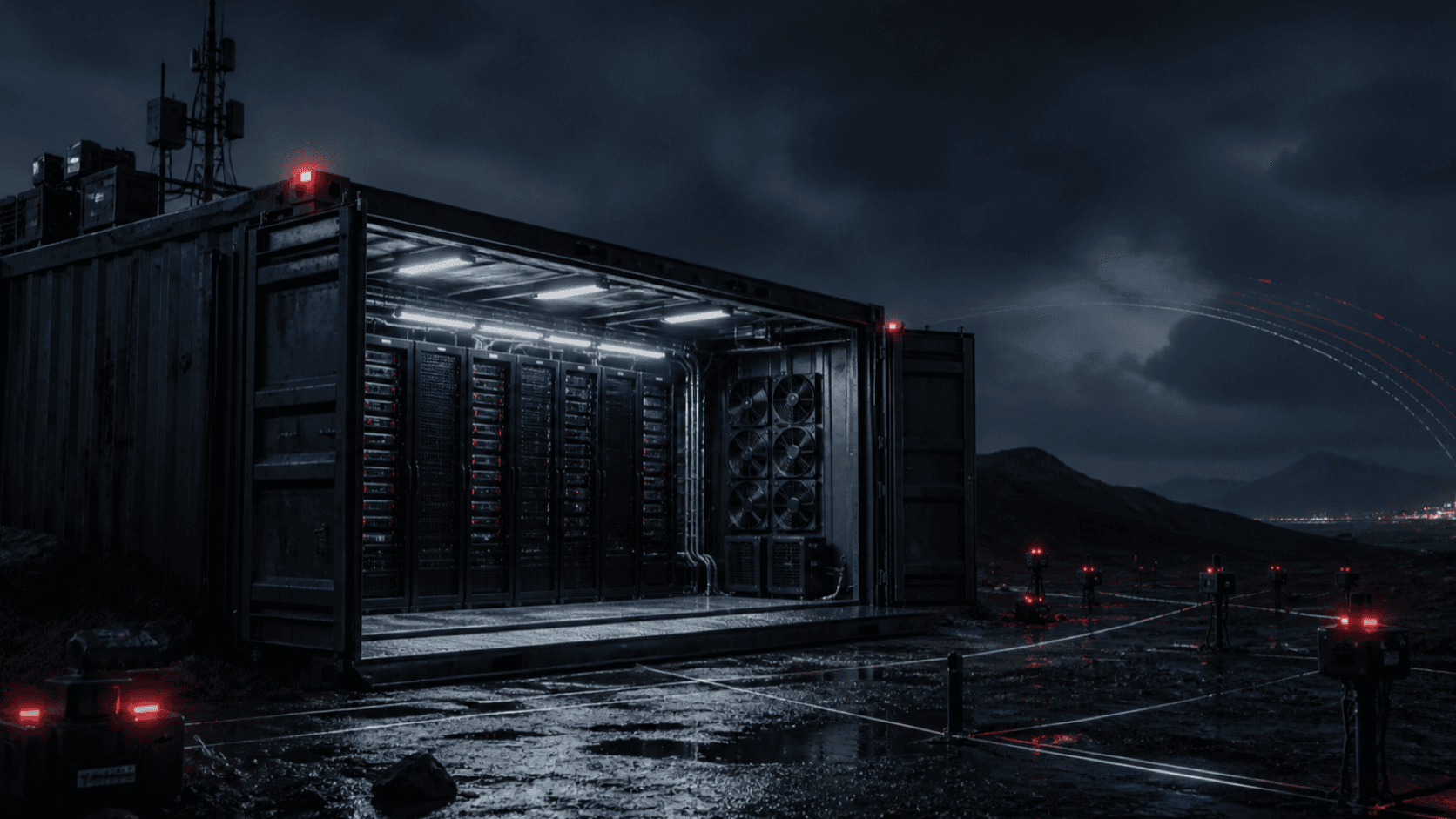
Sources: TechRadar reporting on Palantir and Armada’s mobile AI deployment, Armada overview of its ruggedized Galleon mobile data centers, Palantir documentation for the Rubix deployment substrate.
Recent reporting describes Palantir and edge-infrastructure company Armada deploying AI data centers built into standard shipping-container footprints for environments where a stable cloud link cannot be assumed. The reported units combine servers, storage, networking, cooling, Nvidia B300 accelerators, and Palantir software so models can process information close to where it is collected.
The idea is broader than a portable server room. Local inference can reduce latency, limit the amount of raw sensor data crossing unreliable links, and keep selected workflows operating while disconnected or isolated. Armada markets its Galleon line as ruggedized mobile infrastructure, while Palantir’s Rubix layer is designed to deploy containerized workloads across constrained environments.
Resilience shifts from the network to the node
A conventional AI service depends on a chain that may include a device, local network, carrier, cloud region, and external model endpoint. Moving compute to the edge shortens that chain. If communications are jammed, damaged, expensive, or deliberately disabled, the local system may still analyze data and support a narrow workflow.
That does not eliminate failure; it concentrates it. A mobile node has finite power, cooling, storage, spare parts, and physical protection. Operators need a degraded mode, tested backups, signed software updates, and a plan for what happens when the unit is captured, damaged, or cut off longer than expected.
Air-gapped is a mode, not a magic word
Reporting says the containerized units can be isolated from external networks. Isolation can reduce remote exposure, but it does not prove the full system is secure. Models, updates, logs, credentials, and retrieved data still cross boundaries at some point. Removable media, maintenance access, supply-chain compromise, and misconfigured synchronization can bridge an air gap.
A credible design needs hardware-backed identity, encrypted storage, measured boot, least-privilege services, tamper evidence, controlled export, and an auditable update path. Sensitive raw data should expire locally when its operational need ends. A container should not become a permanent, poorly inventoried archive simply because bandwidth was limited.
Human authority cannot disappear at the edge
Palantir’s defense context makes oversight especially important. Local AI may fuse sensor streams or prioritize information, but speed does not make an output correct. Teams need visible confidence limits, source provenance, clear separation between recommendation and action, and named humans accountable for consequential decisions.
There is not yet public independent evidence showing how the reported Palantir-Armada configuration performs under sustained field conditions. Until that exists, claims about resilience and capability should be treated as design goals. Containerized AI is a real infrastructure direction with uses in remote industry, disaster response, science, and defense. Its value will depend on whether physical resilience arrives with equally strong privacy, security, and decision controls.
Quick questions
What is a containerized AI data center?
It is a mobile or rapidly deployable enclosure that packages compute, storage, networking, power interfaces, and cooling so AI workloads can run near their data source.
Can these systems operate without the cloud?
They can be designed for disconnected or isolated operation, but capabilities depend on which models, data, power, and services are available locally. Updates and data transfer still need a controlled process.
Has the Palantir-Armada system been independently validated?
Public reporting describes the deployment and its intended design, but it also notes that no independent public verification of sustained field performance was available.